
The Landscape Company
Driveway Construction Standards
A driveway is one of the most highly loaded surfaces around a home. Unlike patios, it carries repeated vehicle loads, turning forces and concentrated stresses from tyres and brakes. When the structure beneath is wrong, the problems usually show within a few winters: rutting, sinking, standing water, cracking and edge failure.
This page explains driveway construction as a structural system — from sub-base depth and edge restraint to drainage, membranes and cement behaviour. The aim is simple: to show what has to happen underneath the visible surface for a driveway that stays stable for years rather than slowly breaking apart.
If you’re also looking at terrace or garden areas, you may find it helpful to read this alongside our Patio Construction & Paving Structure DAP and our Membranes & Geotextiles MDAP, which cover the materials that sit between the soil and the surface.
A driveway doesn’t just carry weight — it carries moving weight. That single difference changes the rules.
Almost every visible driveway failure is the surface telling you that the structure beneath was under-specified for those forces. The surfacing material can be excellent; if the foundation is wrong, the outcome is the same.
Sub-base depth is one of the main differences between a lightly loaded patio and a driveway that will see years of vehicle use. Although every site is different, it helps to think in bands:
Depth alone isn’t enough. The sub-base has to be:
Our Sub-Base Materials MDAP looks in more detail at MOT Type 1, Type 3 and alternative aggregates, and where each is appropriate.
Edge restraint is the part of driveway construction most people notice only when it has already failed: blocks drifting, tarmac feathering away, slabs shuffling at the border between hard and soft.
On a driveway, the edges carry an enormous share of the work:
Proper edge restraint usually means:
Where driveways meet lawns, gravel or planting, we treat the edges as structural components, not just a tidy border.
Water always finds the lowest and easiest route. On a driveway, that might be:
Good driveway drainage looks at all three dimensions at once:
That’s why driveways are closely tied to our wider Garden Drainage & Groundwater Behaviour DAP. When the hard surface, sub-base and drainage are designed together, you avoid both puddles and hidden saturation beneath.
Membranes are useful tools, but they cannot rescue an under-built driveway. They work best when they are part of a coherent structure:
They are not:
We outline correct use, installation overlaps and typical specifications in more detail in the Membranes & Geotextiles MDAP, which applies to both patios and driveways.
Different driveway surfaces change how loads are transferred into the base. The structure beneath adapts to suit.
When block paving dips or ruts, the cause is almost always in the sub-base or subgrade, not the blocks themselves.
Wherever concrete, mortar or bedding is used in a driveway, it follows the same principle as patios: cement cures by hydration, not by “drying out”.
What this means in practice:
On driveways we see this in:
The same interface principles we discuss in the Patio Construction DAP apply here: controlling moisture at the bond line, avoiding thirsty substrates and respecting curing time.
Over time, certain patterns repeat themselves.
Almost all of these can be avoided when excavation, sub-base, drainage and edge restraint are treated as one system rather than separate items.
In real gardens, a driveway rarely exists in isolation. It often ties into:
The details that matter:
Our Retaining Walls & Level Changes DAP sets out how we approach stepped driveways, raised parking areas and transitions into gardens.
A well-designed driveway should feel unremarkable underfoot and under tyre — in the best possible way. It simply works: no scraping over changes in level, no puddles against the house, no creeping edges or early rutting.
When we design and build driveways, we start with the structure first: loads, ground, depth, drainage and edge restraint. Surface material comes after the foundations are right.
If you’d like to talk through an existing driveway that is starting to fail, or plans for a new parking area, we’re happy to look at it in structural terms and outline sensible options.
Driveway performance is closely linked to how you handle water, ground and the “invisible” materials below the surface. These guides explore those areas in more detail and link directly into the same structural logic.
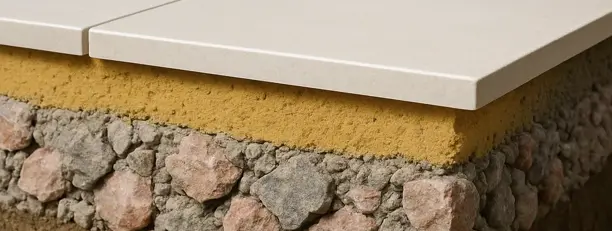
How slabbed areas behave as structural systems: full bedding, bonding, cement curing and why patio failures often start long before anything is visible on the surface.
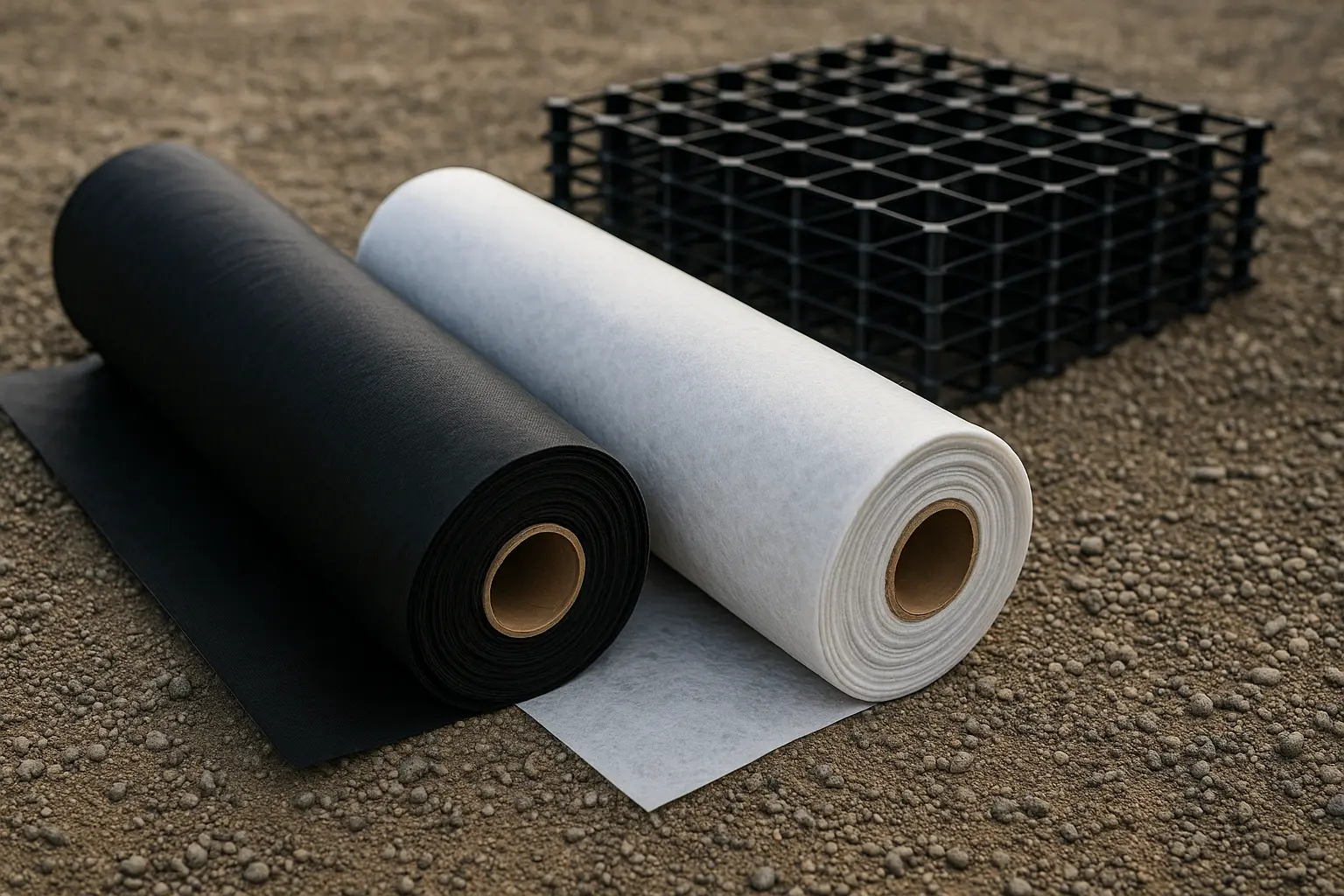
When and how to use separation fabrics, reinforcement grids and weed-suppressing geotextiles — and where they sit in the build-up beneath both patios and driveways.
Most early driveway failures can be traced back to insufficient excavation depth, inadequate sub-base thickness, poor compaction or weak edge restraint. Vehicle loads and turning forces quickly reveal where the foundations were under-specified for the ground conditions and use.
For typical car-use driveways on reasonably good ground, sub-base depths are often in the 150–200 mm range, compacted in layers. On weaker, clay or filled ground, or where heavier vehicles are expected, build-ups of 200–300 mm or more may be appropriate, always designed to suit the specific site.
Separation geotextiles and reinforcement grids can be very useful tools under driveways, especially on soft or mixed ground, but they cannot replace proper dig depth and compaction. The correct type of membrane depends on whether it is being used for separation, reinforcement or weed control, and it should be specified as part of the whole structure rather than in isolation.
The principles are similar, but driveways often deal with more water and more concentrated loading. Good driveway drainage considers surface falls, collection points such as slot drains and how water is safely discharged to soakaways or drainage systems, while keeping it away from buildings and retaining structures.
Whether you’re replacing a tired driveway, reconfiguring parking or planning a full front-garden redesign, we can help you think through the structure, not just the surface.
Call: 01428 654812 · 07500 877949
Email: richard@tlchaslemere.co.uk
WhatsApp: Send a WhatsApp message
Telegram: Message on Telegram