
The Landscape Company
Patio & Driveway Foundations
Modern patios and driveways rely on more than attractive paving. Much of what determines long-term performance happens out of sight — in the layers of soil, stone and fabric beneath the surface.
One of the most misunderstood parts of that build-up is the use of membranes: heavy-duty geotextiles, geogrids and weed-control fabrics. They are often spoken about as if they all do the same thing. They don’t.
This guide explains what each type actually does, when they genuinely help, and why misusing them often gives a false sense of security instead of durability. It sits alongside our deeper pages on patio structure and failure modes and driveway construction standards.
Before anything else, it’s important to separate membranes into two distinct families:
Confusing these roles is where many long-term paving and driveway problems begin.
Heavy-duty geotextiles are designed to sit between the natural ground and the sub-base. Their job is not to “strengthen” weak soil; it is to manage how the layers interact.
In practice, they are used to:
A useful way to think about them is: they don’t make weak ground strong — they stop good materials being damaged by weak ground.
We use structural membranes selectively, most often where soil behaviour would otherwise compromise long-term stability, for example:
In these cases the membrane acts as a buffer layer, helping the structure above behave more uniformly.
This is where a lot of poor advice creeps in. A structural geotextile cannot:
Soil always moves. Good construction doesn’t try to stop that; it manages it. Membranes support correct build-ups — they don’t rescue incorrect ones.
Geogrids are a different tool again. Rather than acting as a filter, a geogrid works through tensile strength, spreading loads sideways across a wider area.
We may incorporate geogrids where:
They are not used routinely, but in the right conditions they can make a meaningful difference to how a driveway or structural patio behaves over time.
Weed-control fabrics are the thin, felt-like membranes more familiar from garden centres. They are designed to restrict light near the surface, not to carry load or control soil behaviour.
Used correctly, they can work well:
In these settings they slow weed growth and make maintenance easier. What they do not do is reinforce a patio or driveway.
When placed beneath sub-base and mortar, weed membranes are typically:
This is why you often see weeds appearing through joints despite a membrane being installed somewhere underneath. Most weeds in paving don’t grow up from the subsoil; they colonise from above, exploiting light, moisture and small movements at joints and edges.
In permanent hard landscaping, weed prevention is mainly a function of build quality:
When paving is structurally sound, weed growth tends to be superficial and manageable. When there is movement, joints open and organic matter accumulates — and plants simply take advantage of the opportunity.
When membranes are used everywhere, regardless of soil type or loading, it usually reveals one of two things:
Effective groundworks are context-dependent. What makes sense on free-draining sand may be unnecessary — or insufficient — on shrink–swell clay, and vice versa. This is why site-specific judgement matters.
For patios, membranes are considered alongside:
For driveways, additional factors include:
In both cases, membranes are supporting elements. The structure still depends on correct dig, sub-base, laying course and surface specification.
If there is one principle worth remembering, it is this:
Membranes should support good groundwork — not be relied on to replace it.
When construction gets the fundamentals right, geotextiles and geogrids work quietly and effectively in the background. When they are used as a sticking plaster, they usually disappoint a season or two later.
Talk to us about patio or driveway groundwork
Membranes sit between soil and structure. These guides look at the surrounding system — how patios, driveways and drainage are built so that fabrics support good groundwork rather than replace it.
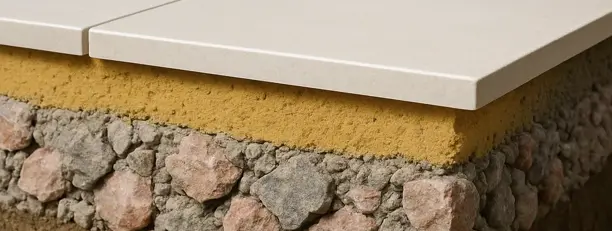
How slabbed areas behave as structural systems: full bedding, bonding, cement curing and why patio failures often start long before anything is visible on the surface.
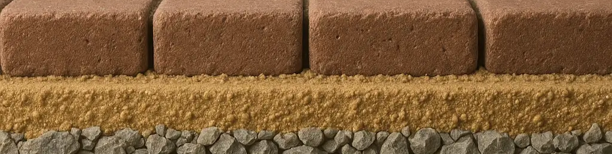
How vehicle loading, sub-base depth, edge restraint and drainage come together – and where membranes genuinely help in keeping driveways stable over time.
Structural geotextiles are heavy-duty fabrics designed to sit between soil and sub-base, helping to separate layers and control fine particle movement. Weed membranes are lighter materials placed near the surface to limit light and slow weed growth. One manages soil behaviour; the other manages surface maintenance.
Most weeds in paving arrive from above, not from deep in the subsoil. They germinate in joints and at edges where light, moisture and organic matter are present. A buried membrane cannot stop this. Correct excavation, full bedding, tight joints and sensible cleaning are far more important than fabric under the stone.
No. Geogrids are most useful on weaker or variable ground, or where vehicle loading and turning forces are high. On suitable subsoils with correct excavation and sub-base, they are often unnecessary. They are a design tool, not a mandatory extra on every project.
No. Membranes support good groundwork but cannot compensate for inadequate dig depth, thin sub-base or poor compaction. Long-term performance still depends on proper excavation, sub-base, laying course and drainage design, with membranes used where they make structural sense.
If you’re planning a new patio, driveway or full garden rebuild, we can design the structure from the ground up: excavation depths, sub-base, membranes, drainage and paving specification.
Call: 01428 654812 · 07500 877949
Email: richard@tlchaslemere.co.uk
WhatsApp: Send a WhatsApp message
Telegram: Message on Telegram