
The Landscape Company
Patio Construction & Paving Structure
This page explains the structural principles behind long-lasting patios: how load is carried, how the ground behaves once it’s disturbed, how cement actually cures, and why drainage and bonding matter far more than most people realise. It’s written for homeowners who want to understand why some patios fail prematurely, even when they look perfectly fine on day one.
Many of the issues we see aren’t obvious at installation. They reveal themselves over seasons of movement, weather and use. This is where careful design and installation make the difference between a patio that simply looks good and one that still works properly years later.
A patio is not a decorative surface. It is a load-bearing structure built on disturbed ground, exposed to water, temperature change and long-term movement. When patios fail, it is almost never the paving slab itself that is at fault – it is the structure beneath that was never properly understood.
Most problems only reveal themselves over time. And by the time they do, correction is expensive.
Patios are often treated as if they only support foot traffic. In reality, they experience a range of loads:
Patios do not fail because they are walked on. They fail because the load has nowhere sensible to go. Cracks almost always propagate upwards – a sign that stress has been concentrated beneath the slab due to voids, weak support, or loss of bond.
The moment excavation begins, the ground stops behaving like natural soil and starts behaving like disturbed material. Different ground types respond very differently:
A patio does not simply sit on “the ground”. It sits on engineered layers designed to control how load and moisture move. Ignoring this is the root of most failures.
Sub-base is often reduced to a line in a quote – “100 mm MOT Type 1”. In reality, thickness alone means very little. A sub-base must:
Recycled materials, poor grading, inadequate compaction or inappropriate thickness all lead to delayed settlement that no surface finish can hide. The sub-base is not there to look tidy. It is there to control movement over years, not days.
A rigid surface cannot tolerate voids beneath it. Where voids exist, stress concentrates. Over time, that stress finds the weakest point, and something cracks, debonds or moves.
Full mortar bedding eliminates void dependency. Systems that leave gaps beneath slabs are simply storing future failure. This is not always immediately visible: some patios feel solid underfoot yet ring hollow when struck – a classic sign that the slab is mechanically resting, not structurally bonded.
One of the most misunderstood aspects of patio construction is how cement actually gains strength. Cement does not harden because it dries out. It hardens because it chemically reacts with water through a process known as hydration.
If water is lost too early – due to heat, wind, dry substrates or very absorbent stone – hydration stops prematurely. The cement sets, but never reaches its intended strength. This matters most at the interface between the slab and the bedding mortar.
When a slab is laid onto a dry or rapidly drying mortar bed – particularly in warm or breezy conditions – moisture is pulled away from the contact zone before hydration can complete. The mortar may set, but the slab never fully bonds to it.
The result is a slab that appears solid but:
This is not a surface issue. It is a bonding failure at the interface.
Porous natural stones such as Indian sandstone can aggressively draw moisture out of fresh mortar. Lightly priming the underside of the slab with a thin cement slurry – bringing it to a saturated surface-dry condition – stabilises hydration at the interface without weakening the mix.
This allows cement crystals to grow through the contact zone, creating proper integration between slab and bedding. The result is dramatically improved bond consistency and long-term performance.
The goal is moisture control, not over-wetting.
Porcelain paving removes any ambiguity. Because porcelain is non-porous, water alone cannot form adhesion. A cementitious slurry primer is structurally essential to create a mechanical and chemical bridge between slab and bedding.
Once this became standard practice, it revealed a broader truth: if full bonding is structurally essential for non-porous material, the same principle still applies – though less visibly – to porous natural stone. Bonding is part of the structure, not an optional enhancement.
Water rarely causes failure on its own. It magnifies weaknesses that already exist.
Poor drainage can:
Falls alone do not control water. Capillary action, perched water tables and blocked escape routes beneath paving all cause long-term instability even where surface drainage appears adequate. Water management is structural, not cosmetic.
Slab thickness, material quality and surface finish do not replace structural design. A premium slab laid on inadequate support will fail sooner than a modest material installed correctly.
Structural logic must always come first – material choice follows. For deeper detail on material behaviour, see our guides on good vs bad porcelain paving and good vs poor quality sandstone.
Not all failures are immediate. Many develop gradually through:
Early performance proves very little. Longevity proves everything.
Planting, turfing and finishing details are often added last – not because they are unimportant, but because they depend entirely on what sits beneath them.
When the structure is right, the garden settles naturally. When it isn’t, soft landscaping becomes the first visible casualty. Beauty is the outcome of correct construction – not a substitute for it.
This page isn’t here to sell paving. It exists to explain why patios must be designed and built as systems – managing load, moisture and movement together – rather than treated as surfaces laid onto whatever happens to be below.
Permanent work deserves permanent thinking.
Patio and driveway performance is closely linked to how you handle water, ground and the “invisible” materials below the surface. These guides explore those areas in more detail and link directly into the same structural logic.
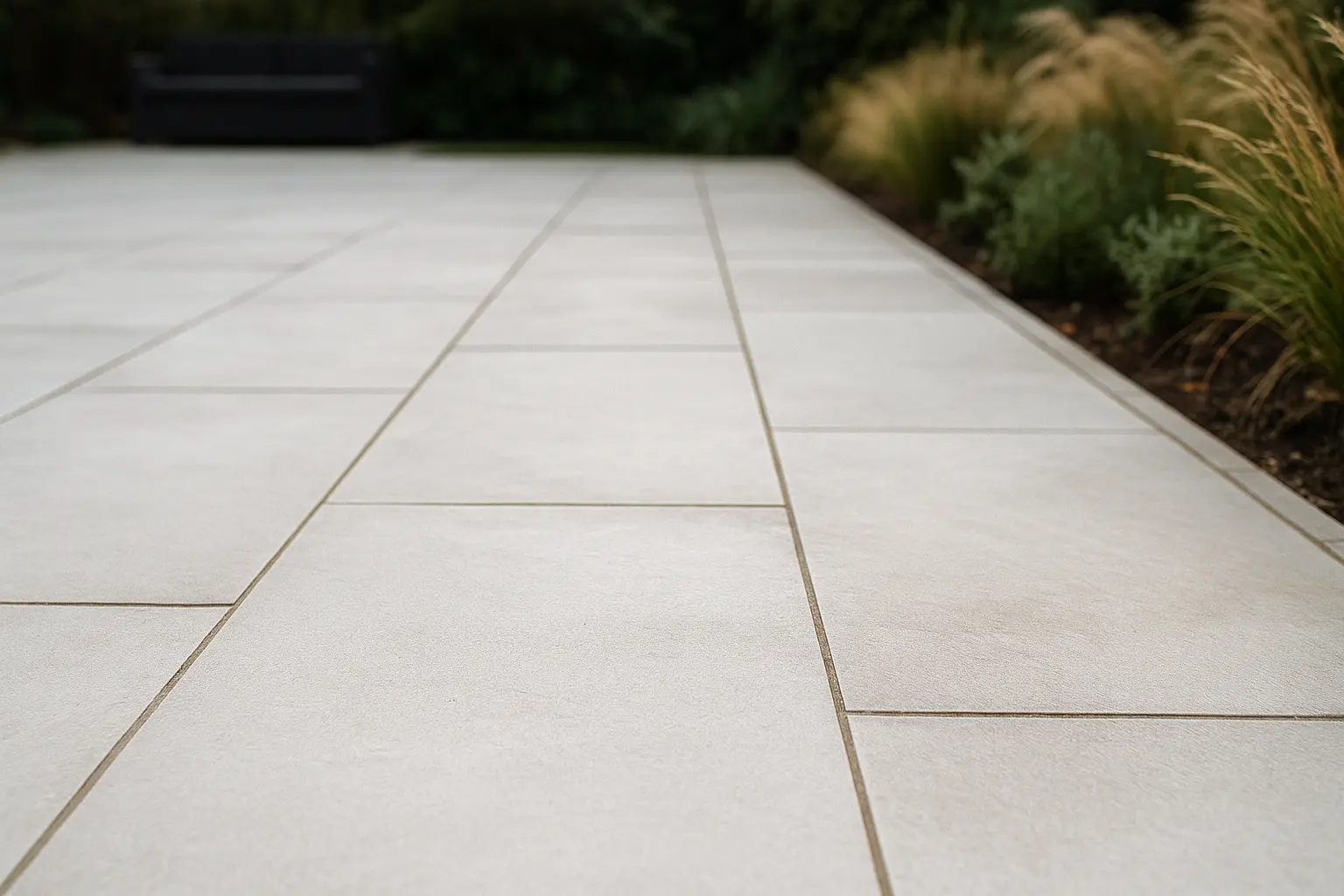
How porcelain is engineered, why some tiles crack outdoors, and how we assess quality before agreeing to install a product.
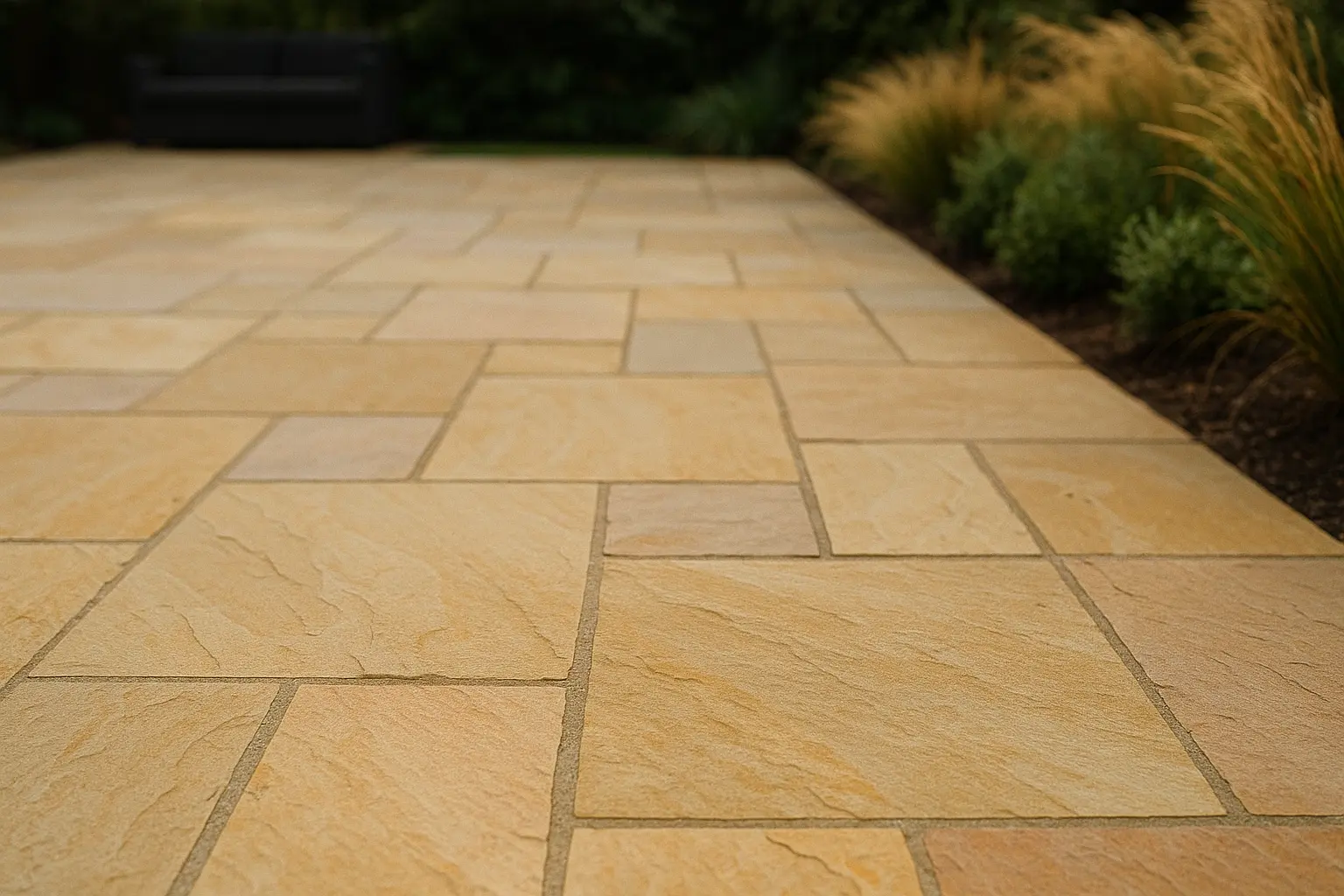
Why some sandstone patios mellow beautifully and others fail, plus insight into quarry quality, test data and ethical sourcing schemes.
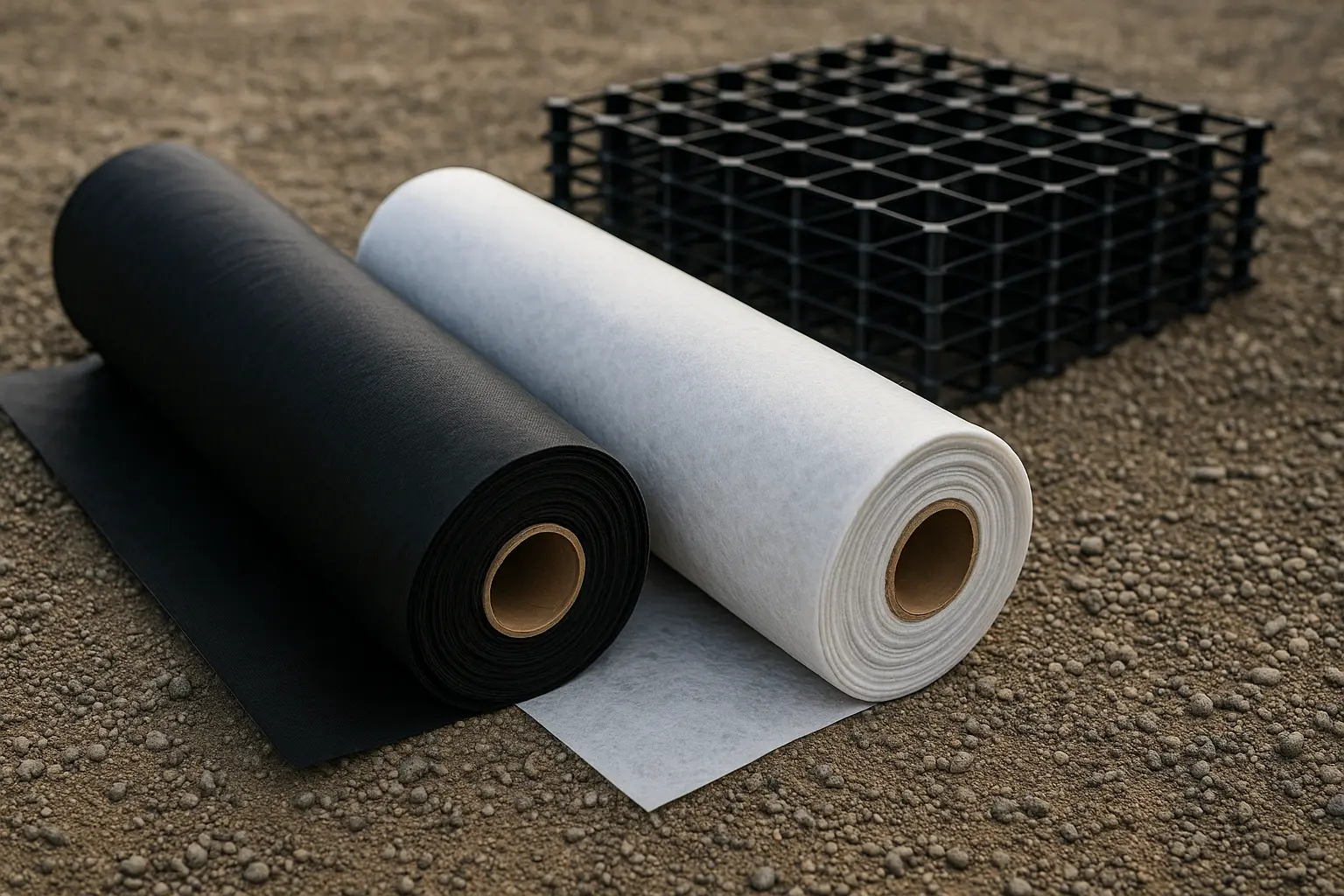
When and how to use separation fabrics, reinforcement grids and weed-suppressing geotextiles — and where they sit in the build-up beneath both patios and driveways.
Slabs usually become loose or sound hollow when they were never fully bonded to the bedding mortar in the first place. This happens when moisture is pulled out of the mortar too quickly, or when voids are left beneath the slab. The mortar may set, but the interface never develops proper strength, so the slab effectively rests on high points rather than behaving as part of a single structure.
Yes. Cement hardens through a chemical reaction with water called hydration. If water is lost too quickly – for example in hot, dry or windy conditions, or into very absorbent stone – the reaction stops early and the cement never reaches its intended strength, particularly at the contact surface between slab and mortar.
A cementitious slurry primer is essential for non-porous materials like porcelain. With natural stone, a light slurry or controlled dampening of the slab underside greatly improves bond consistency by stabilising moisture at the interface. It helps prevent the stone from robbing the mortar of water before hydration has completed.
Many failures develop slowly through ground consolidation, seasonal moisture changes, repeated loading and progressive joint breakdown. Small amounts of movement can accumulate over time, especially where the sub-base, bedding or drainage were marginal to begin with. Early performance often hides weaknesses that only become visible after several cycles of weather and use.
Slab thickness alone does not guarantee a stronger patio. Strength comes from the whole system – ground preparation, sub-base design, bedding, bonding and drainage. A thicker slab on poor support can fail sooner than a thinner slab laid on a well-designed structure.
If you are planning a new patio, or want a second opinion on how an existing design will cope with your ground and usage, we are happy to share practical advice based on real installations in and around Haslemere, Petersfield, Godalming, Guildford and Chichester.
Call: 01428 654812 · 07500 877949
Email: richard@tlchaslemere.co.uk
WhatsApp: Send a WhatsApp message
Telegram: Message on Telegram