
The Landscape Company
Guildford · Surrey
Choosing between porcelain and sandstone is one of the most common decisions Guildford homeowners face when planning a new patio. Both materials are excellent — the right choice depends on your home’s style, garden conditions and how much long-term maintenance you want.
This guide explains the differences, benefits and drawbacks of porcelain and sandstone specifically for Guildford and surrounding areas such as Burpham, Merrow, Bramley, Shalford and Stoughton.
Porcelain paving is a man-made product created from refined clay and minerals baked at extremely high temperatures. This process makes it one of the most durable and low-maintenance patio materials available.
Sandstone is a natural stone quarried in large slabs, each piece having unique colour variation and texture. It suits both traditional Surrey homes and rustic gardens.
The Guildford area experiences:
These factors mean:
Most outdoor porcelain tiles have an R11 slip rating, which provides excellent grip year-round. Sandstone varies: some riven finishes are grippy, while honed or smooth sandstone can become slippery when wet.
Both materials need correct installation, but porcelain is more technical:
Sandstone, while easier to work with, still requires:
These ranges are typical for Guildford installations (materials + labour):
Every garden is different. If you're in Guildford, Burpham, Merrow, Shalford, Bramley or the surrounding Surrey Hills and are unsure whether porcelain or sandstone is best for your patio, we’d be happy to advise.
If you are weighing porcelain against sandstone for a Guildford garden, these deeper guides explain how each material is made, how it performs outdoors, and what really matters beyond the brochure photographs.
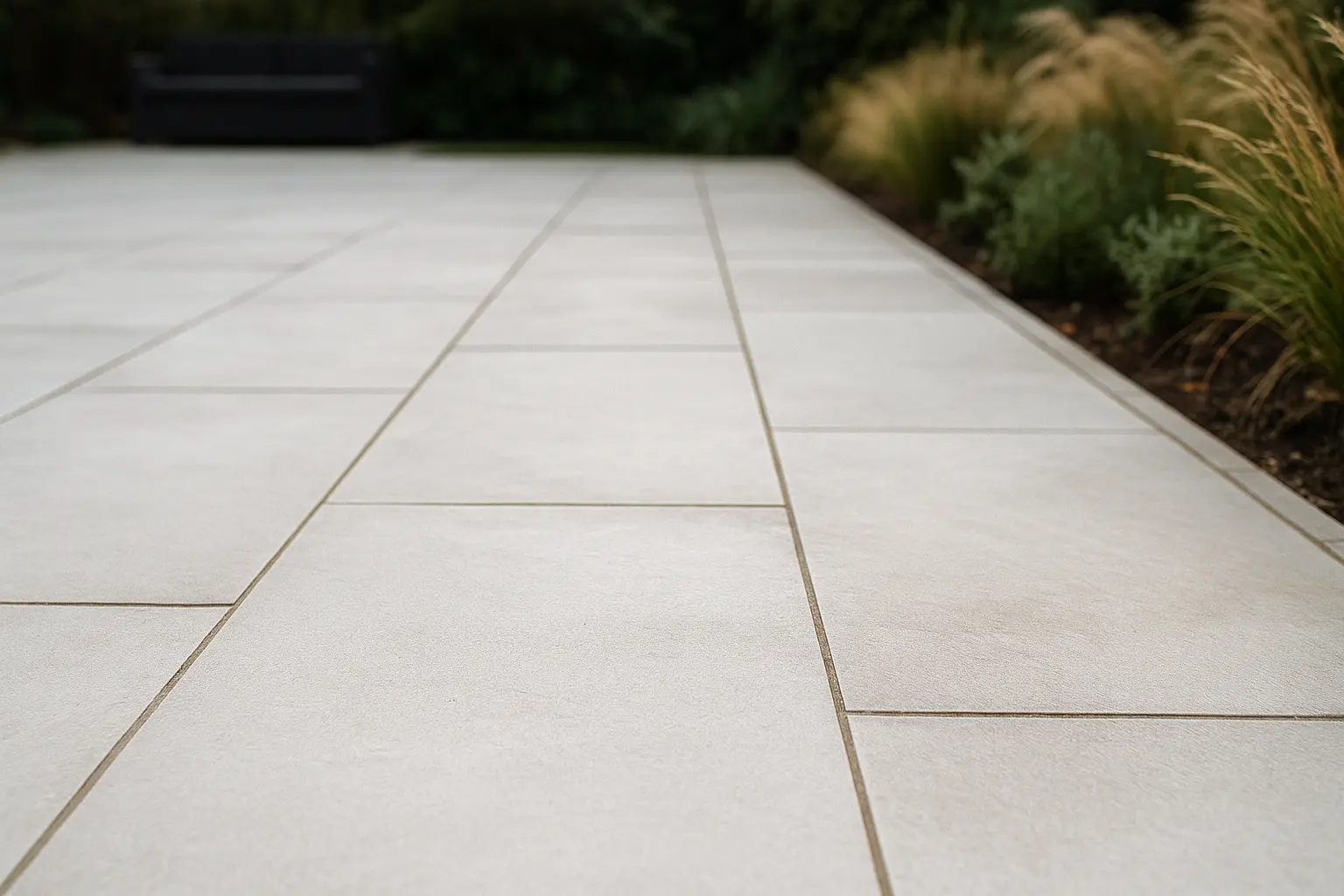
How porcelain is engineered, why some tiles crack outdoors, and how we assess quality before agreeing to install a product.
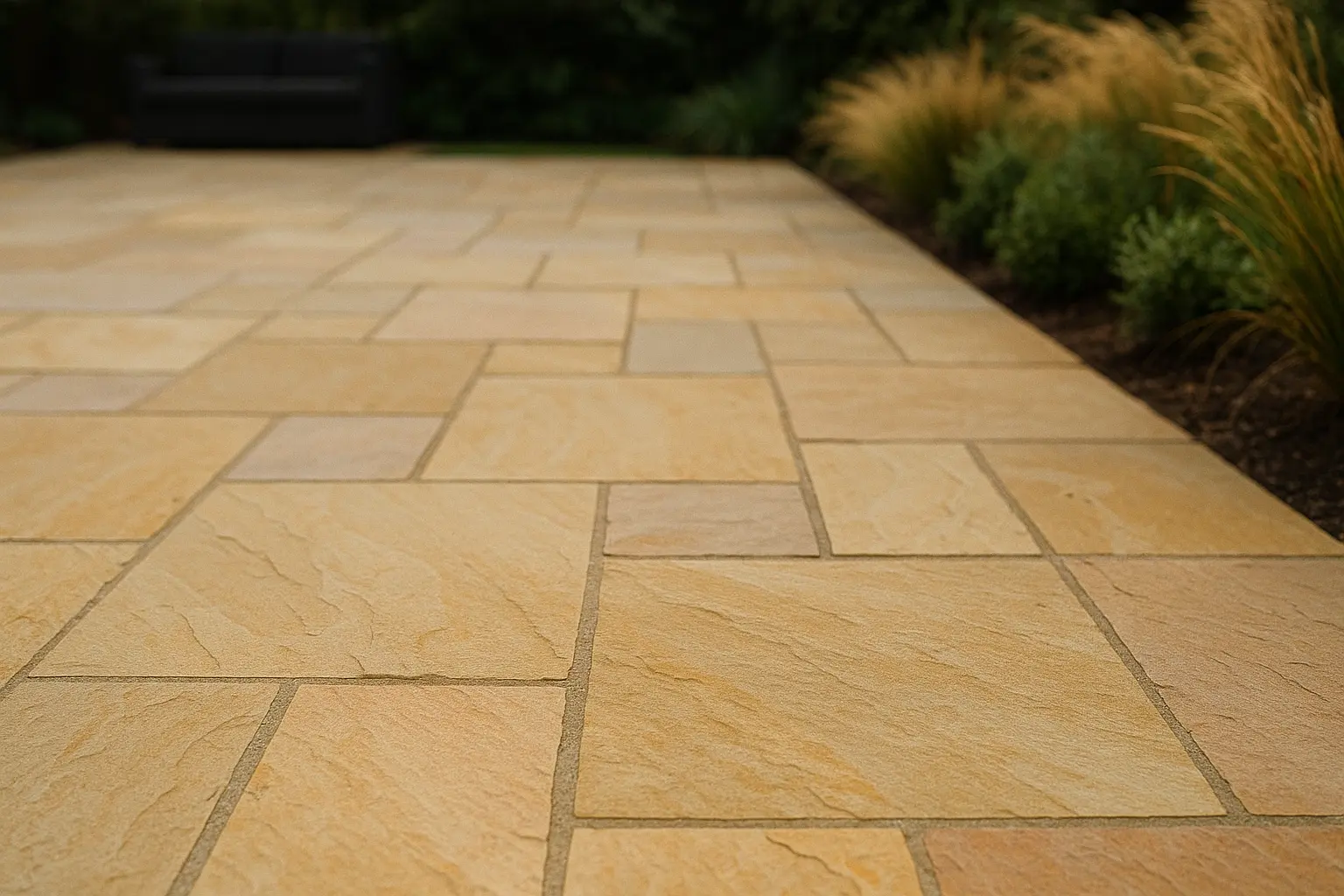
Why some sandstone patios mellow beautifully and others fail, plus insight into quarry quality, test data and ethical sourcing schemes.
Porcelain works very well on stepped terraces and level changes as long as the build-up and nosing details are designed properly. The important part on Guildford’s steeper plots is the retaining structure, drainage and step geometry beneath the paving. Once that is correct, both porcelain and sandstone perform reliably – the choice is more about appearance and maintenance than slope alone.
In tree-lined streets, along the Wey corridor or on north-facing slopes, we usually recommend sealing sandstone to slow down algae growth and leaf staining. A good breathable sealer makes periodic cleaning easier and helps the stone age more gracefully. Porcelain, by contrast, is much less absorbent and often manages fine with simple wash-downs, even in deep shade.
Both materials can pick up general grime near busy roads, but porcelain is less porous so dirt tends to sit on the surface and rinse away more easily. Sandstone’s open structure can hold on to fine particles, especially on pale or honed finishes. Good falls, sensible gully positions and the occasional soft wash usually keep either material looking smart in and around Guildford town.
There is usually a small uplift for porcelain because of the extra labour involved in cutting, priming and laying it on full beds. However, on many Guildford projects the major cost drivers are excavation, spoil removal, access, retaining walls and drainage rather than the slabs themselves. We normally price both options side by side so you can see the true difference once your specific garden conditions are taken into account.
Explore all of our in-depth landscaping guides for Guildford, Burpham, Merrow, Shalford, Bramley, Stoughton and the surrounding Surrey Hills:
If you’re considering a new driveway, patio or full garden transformation, we’d be happy to talk through your ideas and advise on the best way forward.
Call: 01428 654812 · 07500 877949
Email: richard@tlchaslemere.co.uk
WhatsApp: Send a WhatsApp message
Telegram: Message on Telegram